 Healthcare facilities across India, especially in fast-growing centres like Ahmedabad and Gujarat, rely on door systems that go far beyond simple entry and exit. These doors control infection, maintain life-saving air pressure, stop fire and smoke, and allow smooth movement of patients, staff and equipment — often all at the same time.
Hospital administrators, architects, NABH teams, turnkey contractors and consultants frequently tell us the same story: during upgrades or new builds, doors are decided at the last minute. One wrong choice delays handover, fails pressure tests or invites audit remarks. This detailed guide combines practical field experience with current standards so you can specify, install and maintain doors confidently from day one.
Why Hospital Doors Are a Critical Safety Component
A door in a hospital is never just a door. It is the boundary between sterile and non-sterile zones, between positive and negative pressure, between safe evacuation and chaos during fire. In Gujarat’s humid climate and dusty construction sites, seals degrade faster, powder coating peels sooner, and hinges loosen quickly if the wrong grade is chosen.
A single 2-mm gap under an OT door can raise particle count ten-fold. A fire door that does not close fully can cost lives. Thoughtful door selection therefore directly affects patient outcomes, staff efficiency and long-term maintenance cost. Many hospitals now prioritise infection control with hospital doors during planning stages.
Types of Doors Used in Modern Indian Hospitals
Operation Theater Doors
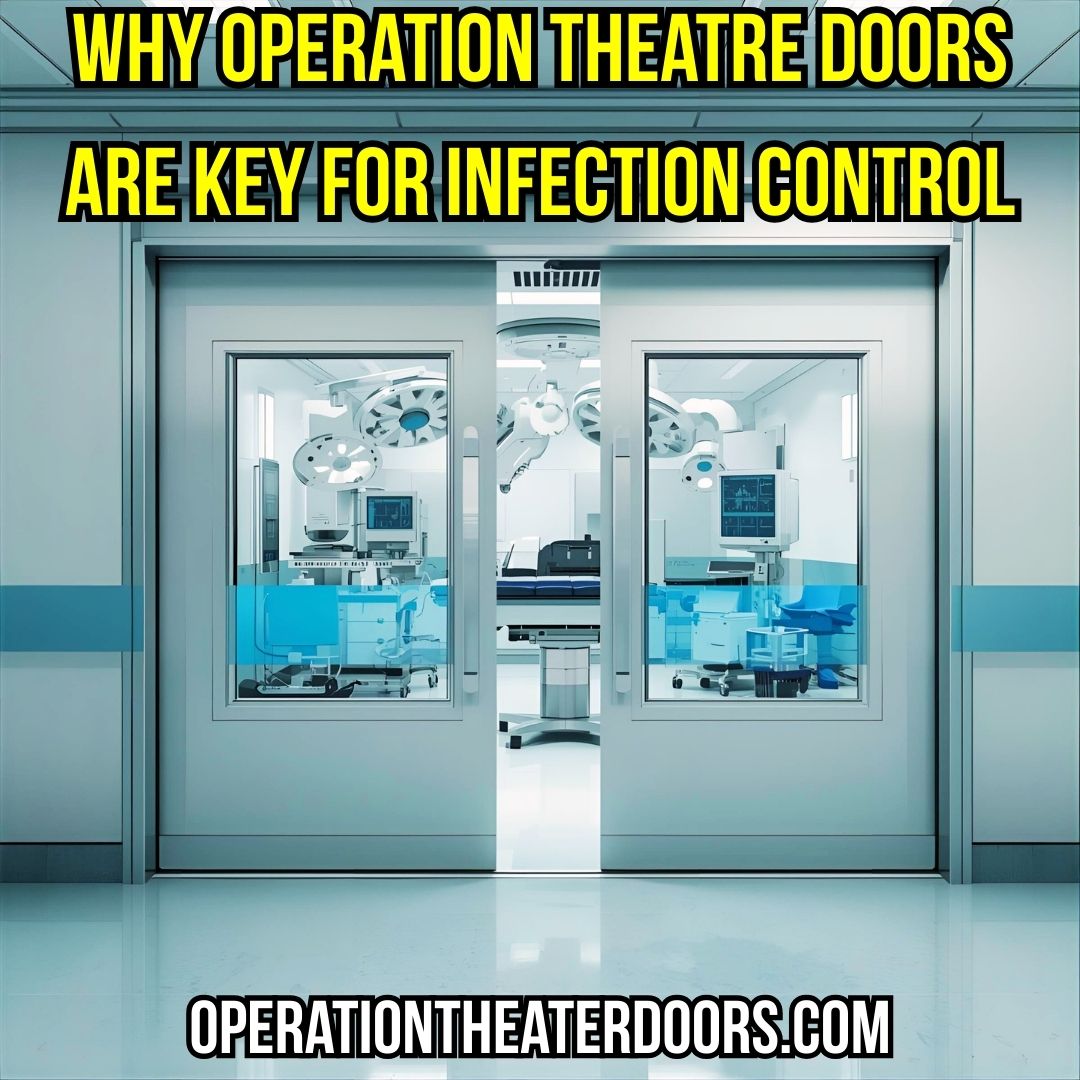
OT doors carry the heaviest responsibility. They must remain hermetically sealed, open wide enough for trolleys, and close without slamming. Most new modular OTs in Ahmedabad use automatic sliding hermetic doors with flush finish and radiation protection where needed. Explore standard OT configurations here: Operation Theatre Doors. Many healthcare planners also compare sliding vs swing OT doors before finalising layouts.
ICU and Critical Care Doors
ICUs need doors that open silently, resist constant trolley impact and maintain slight positive pressure. Large vision panels (minimum 300 × 450 mm) let nurses monitor patients without breaking the seal. Soft-close mechanisms and 450-mm-high kick plates are now standard. Typical ICU door details are available at ICU Doors. Proper door specification also plays a major role in ICU patient safety and workflow management.
Cleanroom and Pharma Doors
IVF labs, stem-cell units, diagnostic labs and pharma production areas demand ISO-class particle control. Cleanroom Flush Doors with PUF Panel core, epoxy or SS 304 skin, and zero-undercut design are the only acceptable choice. See cleanroom door range here: Cleanroom Doors. Many Gujarat pharma units also refer to material guidelines on Pharmaceuticals industry page and follow recommendations for GMP compliant doors.
Fire Exit and Emergency Exit Doors
Every escape route door must swing outward, carry 60–120 minute fire rating, and open with panic hardware using ≤70 N force. Vision panels and luminous “EXIT” signage in English + regional language are mandatory. Standard fire door options are listed under Fire Exit Doors. Hospitals increasingly integrate these systems with broader fire exit door safety strategies.
Materials that Perform under Indian Conditions
PUF Insulated Doors and Panels
50–60 mm PUF core (40 ± 2 kg/m³ density) gives excellent thermal insulation (U-value ≈ 0.4 W/m²K), sound reduction (STC 32–38) and structural rigidity. Skins in 0.8 mm pre-coated GI or SS 304 with antimicrobial powder coating last 10–15 years even with daily hypochlorite wiping. Full PUF door catalogue: PUF Insulated Doors. Healthcare consultants also evaluate PUF insulated door performance in healthcare environments before procurement.
Stainless Steel vs Powder-Coated Steel
SS 304/316 is ideal for OT, ICU and cleanrooms because it tolerates 5000+ cleaning cycles without pitting. Powder-coated GI works for general corridors if edges are properly sealed and coating thickness ≥80 microns). Material selection often depends on lifecycle cost, hygiene requirements and durability expectations discussed in OT and ICU door material comparisons.
Lead-Lined and Radiation Doors
CT, cath-lab and LINAC rooms need 1–3 mm lead equivalence certified by AERB. Doors weigh 80–150 kg, so heavy-duty tracks and floor guides become essential.
Hermetic Sealing and Pressure Management
A true Hermetical Door seals on all four sides using compressed neoprene or silicone gaskets plus an automatic drop-seal. Pressure drop across the closed door should not exceed 2–3 Pa in 10 seconds. Proper sealing systems are critical for maintaining sterile hospital zones.
In practice, Gujarat hospitals now demand on-site pressure-decay testing for every OT and isolation-room door before handover. Sensors linked to the BMS trigger alarms if pressure falls below 10 Pa positive in OT or 2.5 Pa negative in isolation areas. Air leakage prevention is also closely connected with cleanroom pressure and temperature control.
Hygiene Features that Actually Work
- Completely flush surface — no lips, no raised edges
- Rounded corners (R ≥ 5 mm) inside vision panels
- Hidden or flush-mounted hinges
- 300–450 mm SS kick plates and push plates
- Double-glazed desiccant-filled vision panels (no fogging even at 90 % RH)
- Silver-ion or copper-infused antimicrobial coating (99.9 % reduction in 24 h, tested to JIS Z 2801)
Daily cleaning with 1 % sodium hypochlorite or 70 % IPA should not fade colour or reduce coating adhesion even after 1000 cycles.
Fire Safety and Smoke Control
NBC 2016 Part 4 and Gujarat Fire Safety Rules require:
- Intumescent seals that expand at 150 °C
- Smoke seals (cold smoke) on all four sides
- Self-closing devices with hold-open magnets linked to fire alarm
- Sequential closers on double-leaf doors
- “Fire Door – Keep Shut” signage in minimum 50 mm letters
Monthly drop tests and annual third-party certification are common practice in NABH hospitals. Facilities preparing for accreditation also review hospital door compliance requirements for NABH and safety audits.
Automation and Touchless Operation
Post-pandemic, almost every new or renovated facility in Ahmedabad specifies touchless activation — radar sensors, elbow switches, foot pedals or wave-to-open plates.
Automation must include:
- Anti-crush safety (immediate reversal if obstruction detected)
- Battery backup ≥30 minutes
- Manual override from both sides
- Integration with access-control and fire-alarm panels (doors fail-safe open on fire alarm)
HVAC and HEPA Filtration Integration
Doors form part of the pressure envelope. Return-air grilles are placed close to doors to capture escaping particles instantly. Transfer grilles with fire dampers are used where direct openings are unavoidable.
In laminar-flow OTs, door opening cycle is restricted to <4 seconds to minimise turbulence over the operating table. These airflow considerations are discussed further in modular OT airflow and infection control design practices.
Key Compliance Standards You Must Satisfy
| Standard | Key Door-Related Clause | Reference |
|---|---|---|
| NABH 5th Edition | FMS 4, 6, 7 – cleanable surfaces, fire doors, pressure | nabh.co |
| NBC 2016 Part 4 | Fire & life safety, escape routes | bis.gov.in |
| WHO Good Practices | Surgical infrastructure, airflow stability | who.int |
| GMP Schedule M | Cross-contamination control, cleanable materials | cdsco.gov.in |
| ISO 14644-1 | Cleanroom particle limits & pressure cascade | iso.org |
Keep third-party test reports (fire rating, antibacterial efficacy, pressure decay) ready for every assessor visit. Facilities operating clean environments often align these reports with ISO 14644 cleanroom validation standards.
Modular OT and Turnkey Advantages
Factory-built Modular Operation Theatres with pre-hung PUF Panel doors reduce site time from 90 days to 21–28 days. Wall and door panels arrive colour-matched, hardware pre-fitted, and wiring conduits embedded. Site joints are sealed with medical-grade silicone — no welding, no rust risk later. Typical modular setups: Modular Operation Theatres. Many healthcare groups now prefer turnkey healthcare infrastructure execution to reduce coordination failures.
Selecting the Right Manufacturer — Practical Checklist
- In-house PUF panel production (not outsourced)
- Minimum 10 completed NABH/GMP projects in last 3 years
- On-site pressure-decay and smoke-test capability
- Guaranteed response time ≤4 hours in Ahmedabad metro
- Willingness to provide physical mock-up before order
- Valid test certificates from NABL-accredited labs)
Regional Insights — Ahmedabad & Gujarat
With 180+ NABH facilities and dozens more under construction, Ahmedabad demands doors that handle 45 °C summer, 90 % monsoon humidity and cement dust from nearby sites. Local manufacturers who test products at 50 °C and 95 % RH give far better longevity than generic suppliers. Many hospitals sourcing locally also evaluate trusted ICU and OT door manufacturers in Ahmedabad.
Frequently Asked Questions
What is the minimum clear opening width for OT and ICU doors?
1200 mm for single-leaf OT, 1500–2000 mm for double-leaf or when bariatric beds are used. ICU corridors carrying two stretchers simultaneously need 2400 mm clear corridor width, hence 1200 mm doors minimum.
Do all OT doors have to be automatic?
Not mandatory, but sliding automatic hermetic doors are strongly preferred because they reduce air turbulence and touch points. Swing doors are accepted if cycle time <6 seconds and sealing is proven.
How is hermetic performance tested on site?
A calibrated blower door creates known pressure (50 Pa). Decay to 25 Pa is timed. Good hermetic doors take >20 seconds; average hospital doors fail in 3–4 seconds.
Which coating survives daily hypochlorite wiping?
Antimicrobial polyester powder coating ≥80 micron or SS 304 skin. HPL laminate starts bubbling after ~200 cycles of 1 % hypochlorite.
Are wooden doors ever allowed inside patient areas?
Never in critical zones. Only treated flush doors with 60-minute fire rating are permitted in administrative areas.
How often must fire doors be serviced?
Monthly visual checks + lubrication, quarterly drop test, annual third-party certification mandatory under NBC and most insurance policies.
Can the same door be both fire-rated and hermetic?
Yes, several manufacturers offer 60/120-minute fire-rated hermetic sliding doors for OT escape routes.
What is the typical life expectancy of a hospital door?
With proper maintenance, SS-skinned PUF doors last 12–18 years in Gujarat climate.
Final Thoughts
The right hospital door quietly protects patients and staff every single day. Specify once, install correctly, maintain regularly — and you will avoid audit remarks, infection outbreaks and emergency failures for decades.
For complete design-to-handover support on ICU Setup, Modular OTs, Cleanroom Solutions and compliant door systems, many leading hospitals in Gujarat trust AUM Industries. Visit https://aumindustriesmfg.com/ for technical brochures and project gallery.
For more information, reach Amit Kumar Shrivastav at AUM Industries by visiting operationtheaterdoors.com, emailing amit@aumindustriesmfg.com, or calling/WhatsApp at +91-9274313580. Office: World Trade Tower, A-617, Sarkhej–Gandhinagar Highway, Makarba, Ahmedabad, Gujarat 380051, India.