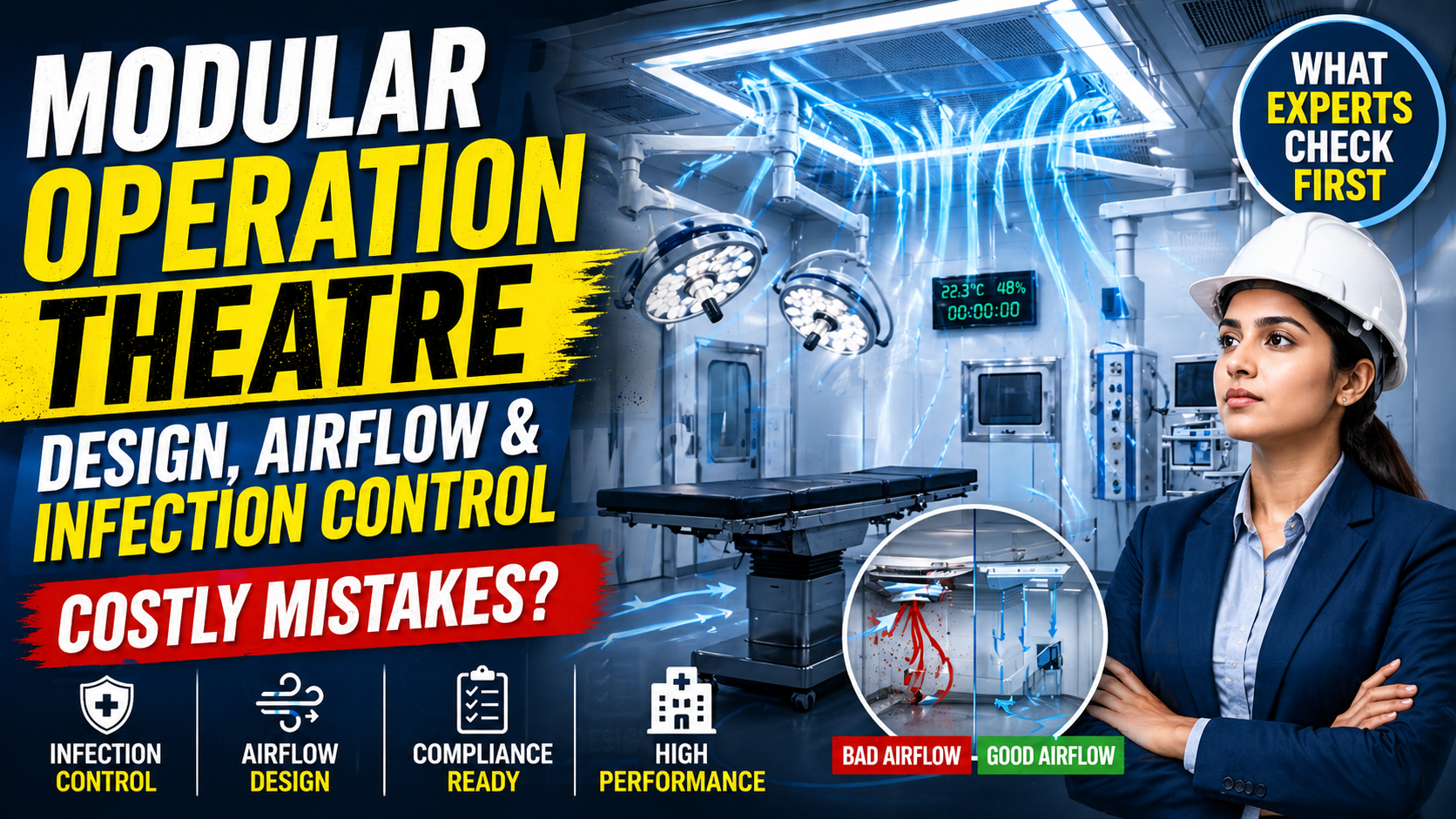
Inside a Modular Operation Theatre: Design, Airflow & Infection Control
A hospital in western India spent nearly ₹2.8 crore building new modular OTs, only to face repeated post-installation corrections within six months. The issue was not the OT lights, laminar airflow unit, or surgical pendants. The real problem was poor coordination between HVAC design, OT layout planning, and infection control protocols. Air changes were incorrect, pressure gradients kept fluctuating, and staff movement patterns were ignored during design.
This happens more often than hospital owners realize.
A modular operation theatre is a prefabricated surgical environment designed using factory-manufactured wall panels, airtight doors, ceilings, HVAC systems, medical utilities, and sterile surfaces to create a controlled environment that reduces infection risk, improves operational efficiency, and supports compliance with NABH, HTM guidelines, and infection prevention protocols.
The biggest misconception in the market is that modular OT projects are mainly interior finishing work. They are not. They are highly coordinated infection-control environments where architecture, airflow engineering, electrical systems, gas pipelines, surgical workflows, and cleaning protocols must function together.
Why Traditional OT Planning Often Fails in Modern Hospitals
Many hospitals still approach OT planning as a civil construction project.
Architects finalize room sizes.
Civil contractors build walls.
HVAC vendors are brought in later.
OT panel vendors arrive after that.
Medical gas contractors come even later.
Then everyone starts cutting, modifying, and adjusting completed work.
That approach creates long-term operational problems.
We regularly see:
- Return air grills placed incorrectly behind equipment
- Surgical pendant clashes with OT lights
- Inadequate ceiling loading calculations
- Wrong pressure zoning between scrub, sterile corridor, and operation room
- Door leakage issues
- Poorly sealed corners causing microbial accumulation
- HVAC duct routing conflicts above false ceilings
- Insufficient maintenance access for HEPA systems
These problems are expensive because correction work happens after expensive imported equipment is already installed.
In high-dependency surgical hospitals, downtime caused by OT rework directly impacts revenue.
Why Modular OT Design Is Becoming the Preferred Model
Modern hospitals prefer modular OT systems because they reduce uncontrolled variables.
Factory-manufactured components improve dimensional consistency.
Wall panels are installed faster.
Medical systems integrate more efficiently.
Cleaning becomes easier.
Future maintenance becomes simpler.
A typical modular OT includes:
- PPGI or stainless steel wall panels
- Flush mounted control panels
- Hermetically sealed doors
- Antibacterial flooring
- Ceiling systems
- HEPA filtration
- Laminar airflow systems
- Medical gas outlets
- Surgeon control panels
- Scrub stations
- Pass-through systems
- Lighting integration
- Pressure monitoring systems
Hospitals upgrading from traditional masonry OTs often move toward complete integrated systems aligned with NABH compliant healthcare infrastructure because compliance pressure has increased.
For hospitals planning complete surgical infrastructure upgrades, modular OT integration often works better when linked with broader turnkey planning through services like modular operation theatres and turnkey projects.
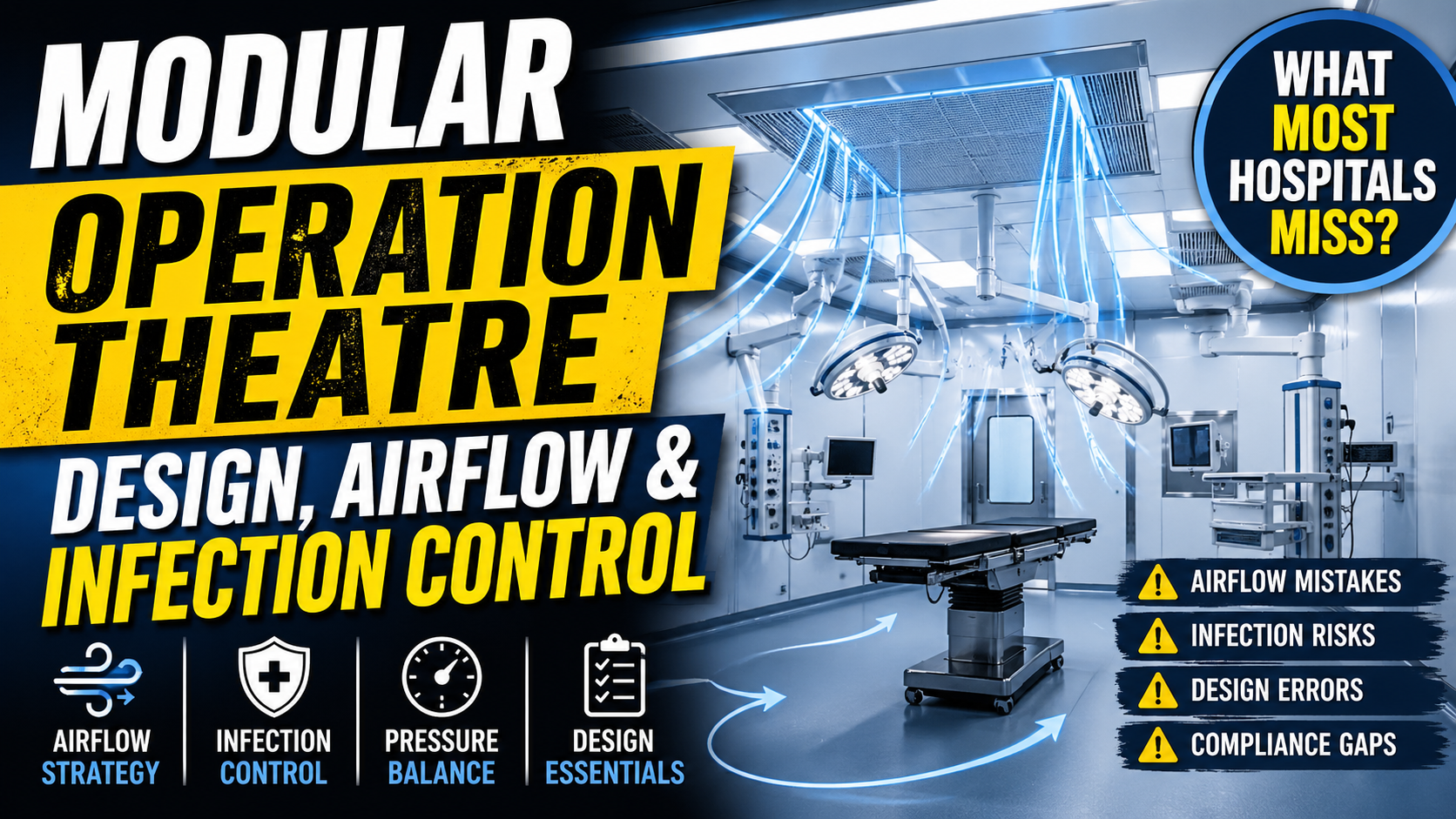
Airflow Design: The Most Critical Component Nobody Sees
Most hospital buyers focus heavily on visible infrastructure.
Doors
Wall finishes
Lights
Pendents
Flooring
But infection control failures often begin with invisible airflow issues.
A well-designed OT must maintain:
- Positive pressure
- Proper air changes per hour
- Controlled temperature
- Controlled humidity
- HEPA filtration efficiency
- Clean-to-less-clean airflow movement
For most critical OTs:
- Air changes often range from 20 to 25 ACH depending on design standards
- HEPA filtration typically reaches H13 or H14 levels
- Temperature is usually maintained between 20°C to 24°C
- Relative humidity often stays between 40% to 60%
Requirements may vary depending on specialty and local regulatory interpretation.
World Health Organization and U.S. Food and Drug Administration frameworks frequently influence infection control expectations in healthcare environments.
Poor airflow design commonly happens when HVAC consultants lack OT-specific experience.
Normal commercial HVAC logic does not work inside surgical environments.
For example:
A retail mall HVAC engineer may optimize energy consumption.
An OT HVAC engineer must optimize contamination control.
These are completely different design priorities.
Laminar Airflow vs Turbulent Airflow: Wrong Decisions Are Common
Many hospitals blindly ask for laminar airflow because they believe it is always superior.
That is inaccurate.
Laminar airflow makes sense in:
- Organ transplant OTs
- Joint replacement OTs
- Neurosurgery OTs
- Cardiac OTs
- High infection sensitivity procedures
For lower-risk surgeries, properly engineered turbulent airflow may be sufficient.
The problem arises when hospitals overdesign systems without understanding lifecycle costs.
Laminar systems increase:
- Capital expenditure
- Filter replacement costs
- Energy consumption
- Maintenance requirements
The decision should depend on:
- Surgery type
- Infection sensitivity
- Hospital budget
- Operational discipline
- Clinical requirements
Why OT Doors Matter More Than Most People Think
Doors are often treated as commodity purchases.
That creates major infection vulnerabilities.
Improper doors lead to:
- Air leakage
- Pressure loss
- Noise issues
- Contamination entry
- Operational failures
Proper OT doors should include:
- Hermetic sealing
- Smooth surfaces
- Sensor integration
- Manual override systems
- Radiation shielding if required
- Fire safety compliance where needed
Many hospitals underestimate how frequently door failures disrupt operations.
Poor sensors, low-grade rollers, and improper installation alignment create recurring maintenance calls.
Specialized operation theatre doors and airtight door systems are often necessary depending on infection control requirements.
ICU-adjacent critical care facilities may also require dedicated ICU doors.
Infection Control Starts With Workflow Design
Even perfectly designed HVAC systems fail when workflow planning is poor.
We often audit hospitals where:
Clean materials enter through contaminated pathways.
Biomedical waste exits through sterile corridors.
Staff movement crosses patient transfer paths.
Scrub room placement increases unnecessary movement.
These operational mistakes increase infection exposure.
Smart OT design separates:
- Sterile movement
- Staff movement
- Patient movement
- Waste disposal routes
- Equipment movement
Good infection control is operational design, not just mechanical engineering.
Materials Selection: A Common Cost-Cutting Mistake
Some buyers aggressively negotiate panel costs.
This usually creates future problems.
Low-quality panels may result in:
- Surface delamination
- Rusting
- Joint failures
- Microbial growth in gaps
- Difficult cleaning processes
Material selection should consider:
- Chemical cleaning resistance
- Impact resistance
- Joint sealing performance
- Repair flexibility
- Long-term appearance retention
For hospitals balancing budgets and durability, cost versus quality in modular OT infrastructure should be evaluated based on lifecycle cost rather than lowest initial pricing.
Common Mistakes During Modular OT Execution
This is where many projects fail.
Design may be excellent.
Execution often ruins outcomes.
Frequent site-level issues include:
- Ceiling cutouts misaligned with drawings
- Wrong medical gas outlet locations
- Improper earthing
- HVAC balancing delays
- Incomplete smoke testing
- Poor silicone sealing
- Door frame misalignment
- Delayed coordination between vendors
One recurring issue is ceiling congestion.
Above modular ceilings, teams often compete for limited space:
- HVAC ducts
- Fire systems
- Electrical trays
- Medical gas pipelines
- Structural supports
Without coordinated drawings, site chaos begins quickly.
Validation Is Often Ignored Until Commissioning
Many hospitals assume installation means project completion.
That is dangerous.
Critical validation includes:
- Air balancing reports
- HEPA integrity testing
- Pressure validation
- Particle count testing
- Temperature mapping
- Humidity validation
- Door functionality testing
- Backup system checks
ISO compliance principles often become relevant where clean-controlled environments overlap with healthcare applications. Referencing frameworks like ISO 14644 cleanroom validation standards becomes increasingly important during commissioning and operational qualification.
Skipping validation creates hidden operational risks.
How Buyers Should Evaluate Vendors
Do not select OT vendors based only on brochures.
Ask:
Who designs HVAC?
Who handles execution?
Who validates airflow?
Who manages after-sales service?
Who coordinates biomedical equipment integration?
Who handles future expansion?
Many companies sell panels.
Very few manage full operational performance.
Hospitals planning integrated environments should prioritize providers offering broader turnkey healthcare infrastructure solutions rather than fragmented vendor structures.
Future of Modular Operation Theatres
The market is shifting toward:
- Touchless systems
- AI-driven environmental monitoring
- Energy-efficient HVAC controls
- Antimicrobial materials
- Remote maintenance alerts
- Faster modular installation systems
But technology alone will not solve poor planning.
The fundamentals remain unchanged:
Good airflow
Proper zoning
Reliable doors
Validated performance
Disciplined maintenance
Final Thoughts
A modular OT should not be judged by how premium it looks during inauguration day.
The real test happens after thousands of surgeries.
Can it maintain pressure stability?
Can it prevent infection risks?
Can it handle maintenance without shutting operations?
Can it support future upgrades?
Hospitals that treat OT construction as a long-term clinical infrastructure decision usually perform better than those chasing the lowest quote.
That difference becomes visible in infection rates, operational uptime, maintenance costs, and clinical reputation.
FAQs
How long does modular OT installation take?
Typically 8 to 16 weeks depending on project size, civil readiness, imported equipment timelines, and validation complexity.
Are modular OTs better than conventional operation theatres?
For modern hospitals, yes. They usually offer better hygiene control, faster installation, easier maintenance, and stronger compliance readiness.
What is the ideal airflow system for an OT?
It depends on surgical specialization. High-risk surgeries may require laminar airflow, while others may operate efficiently with properly designed turbulent airflow systems.
How often should HEPA filters be replaced?
Replacement depends on usage load, air quality, maintenance practices, and pressure drop readings. Regular testing is critical.
What causes most OT failures after installation?
Poor coordination between architecture, HVAC, medical gas systems, equipment vendors, and operational teams.