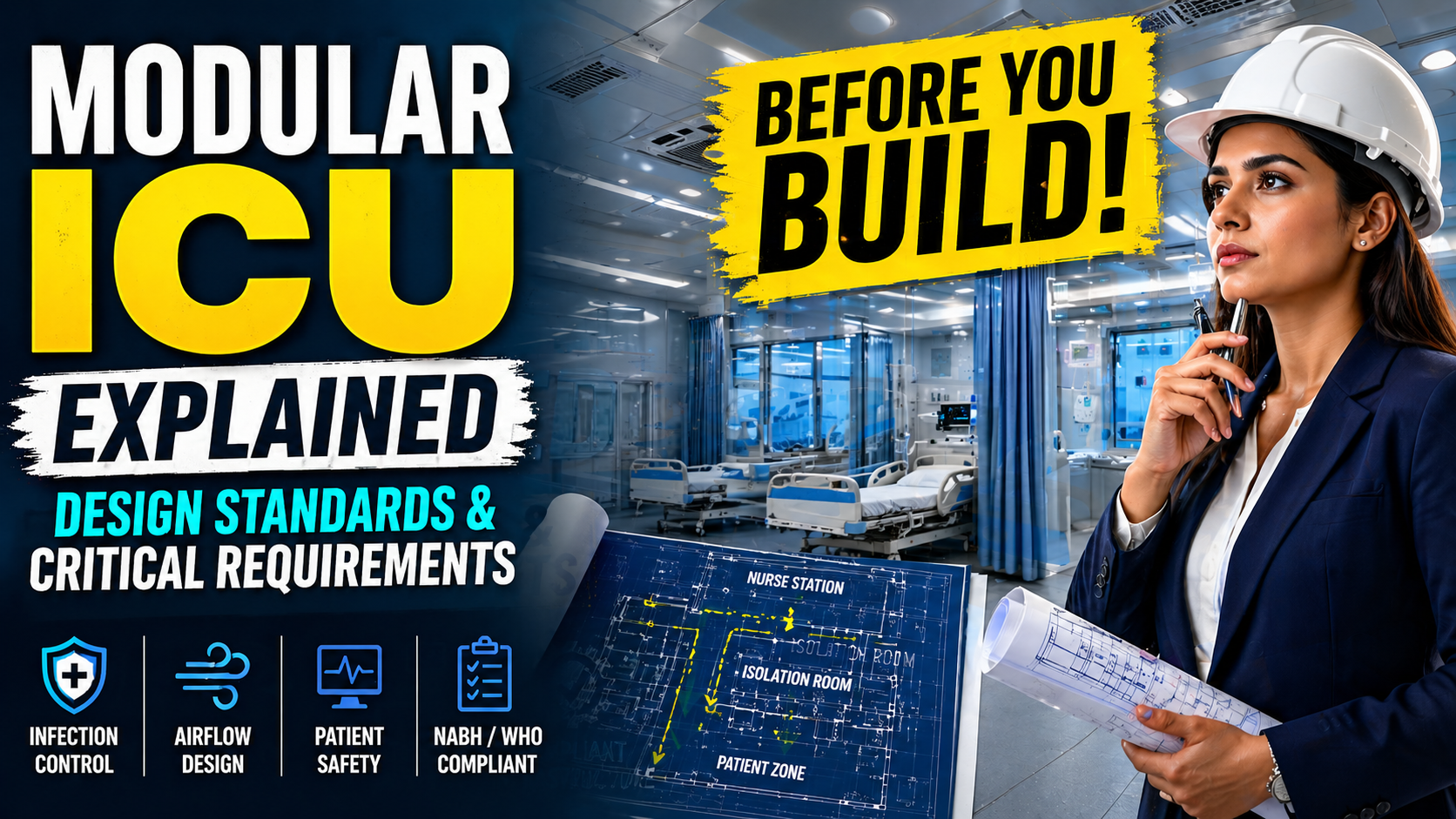
Modular ICU Design Standards: Critical Requirements Hospitals Must Get Right
One of the costliest mistakes hospitals make is treating ICU construction like a normal interior project.
The architect finalizes the floor plan.
Civil work starts.
Beds are ordered.
Then the HVAC consultant arrives late and realizes there is no proper return air planning.
The medical gas vendor flags that outlet locations are impractical.
The biomedical team notices insufficient electrical points for future equipment upgrades.
Infection control teams raise concerns about material finishes.
And suddenly, a project that looked “almost complete” goes back into redesign mode.
This happens far more often than hospital owners realize.
An ICU is not just a room with beds and monitors. It is a high-dependency clinical environment where airflow, infection prevention, emergency accessibility, electrical redundancy, medical gas integration, and staff workflow directly impact patient survival.
A modular ICU is a prefabricated critical care infrastructure system where walls, ceilings, utilities, medical gas pipelines, electrical systems, infection-control surfaces, and workflow planning are integrated into a single engineered solution. It helps hospitals reduce construction timelines, improve operational efficiency, and maintain better compliance standards.
With rising demand for critical care infrastructure in India, especially after COVID-19, hospitals are increasingly shifting toward modular ICU systems. But many still underestimate the technical planning required.
Why Traditional ICU Construction Often Fails
Most ICU failures begin with fragmented execution.
The civil contractor builds walls.
The electrical contractor installs conduits later.
Medical gas teams start routing pipelines after ceilings are partially completed.
HVAC vendors begin duct installation after structural constraints are already locked.
Then clashes begin.
This creates serious problems such as:
- Poor bed spacing
- Improper airflow balancing
- Difficult emergency movement
- Maintenance access problems
- Medical gas routing conflicts
- Poor infection control design
- Future expansion limitations
In one hospital expansion project, improper return air planning created stagnant airflow pockets near patient beds. The hospital had to spend several lakhs redesigning the HVAC system after commissioning delays.
Hospitals trying to avoid multi-vendor coordination issues often prefer complete turnkey healthcare infrastructure solutions.
Facilities building new emergency care infrastructure also evaluate specialized ICU setup solutions.
What Makes a Modular ICU Different?
A modular ICU is designed as a complete clinical ecosystem.
Every infrastructure element is integrated during planning.
That includes:
- Wall systems
- Ceiling systems
- Medical gas integration
- HVAC systems
- Electrical systems
- Monitoring infrastructure
- Infection control planning
- Emergency workflow optimization
Unlike conventional construction, modular systems reduce on-site coordination failures because fabrication and engineering planning happen simultaneously.
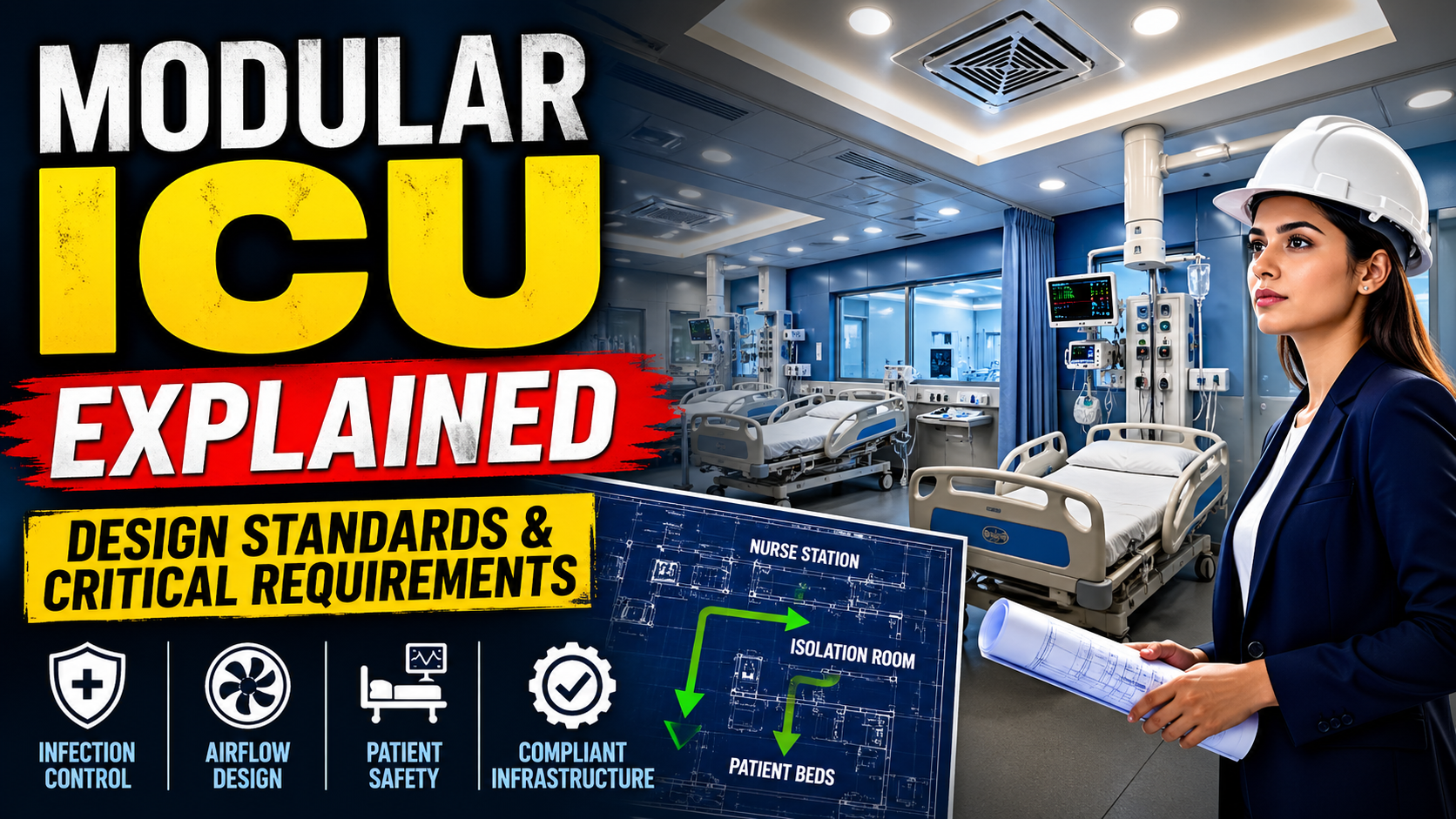
Modular Wall Systems
Wall materials must support infection prevention and long-term durability.
Common materials include:
- PPGI panels
- HPL panels
- Stainless steel sections
- Antibacterial coatings
- Moisture-resistant finishes
These surfaces must tolerate repeated cleaning cycles using aggressive disinfectants.
Low-quality wall systems often show corrosion near humidification areas.
Ceiling Systems and Service Coordination
ICU ceilings must accommodate multiple systems simultaneously.
These include:
- HVAC ducts
- Medical pendants
- Lighting systems
- Fire safety systems
- CCTV
- Nurse call systems
- Access panels
One common mistake is designing ceilings without maintenance access.
If technicians need to break ceilings for repairs, the project was poorly designed.
ICU Door Requirements
Door systems directly affect patient movement and infection control.
Hospitals typically require:
- Automatic sliding doors
- Observation panel doors
- Fire-rated doors
- Isolation room access doors
Properly engineered ICU doors improve emergency access while maintaining hygiene standards.
Hospitals with adjacent surgical zones often install specialized operation theatre doors for better sterile zone separation.
HVAC Requirements in Modular ICUs
This is where many projects fail.
ICU HVAC systems are not designed like normal commercial air conditioning systems.
They must control:
- Temperature
- Humidity
- Air pressure
- Filtration
- Air changes per hour
- Infection containment
Different ICU types require different airflow approaches:
- General ICU
- Isolation ICU
- NICU
- Cardiac ICU
- Burn ICU
- Infectious disease ICU
Negative pressure systems may be required for infectious isolation.
Positive pressure systems may be needed for immune-compromised patients.
Hospitals planning advanced controlled environments often also evaluate cleanroom infrastructure solutions because airflow principles overlap.
For international standards, hospitals should review ASHRAE healthcare ventilation guidelines and applicable WHO infection prevention guidance.
Medical Gas Pipeline Planning
Medical gas integration is frequently underestimated.
Each ICU bed typically requires:
- Oxygen outlets
- Medical air outlets
- Vacuum systems
- Monitoring interfaces
Poor outlet placement creates treatment delays during emergencies.
Clinical teams must be involved during design approvals.
Electrical Infrastructure and Backup Systems
ICUs require uninterrupted power.
Critical equipment includes:
- Ventilators
- Syringe pumps
- Monitors
- Defibrillators
- Dialysis systems
- Infusion pumps
Common mistakes include:
- Insufficient electrical points
- Weak UPS backup planning
- No redundancy planning
- Overloaded circuits
In critical care environments, electrical failure can become life-threatening.
Infection Control Requirements
Modular ICUs perform well when infection control is integrated from the start.
Critical considerations include:
- Seamless wall finishes
- Easy sanitation
- Controlled movement flow
- Hand hygiene stations
- Waste segregation zones
- Isolation flexibility
Hospitals pursuing accreditation should align infrastructure planning with NABH hospital standards.
Common Modular ICU Planning Mistakes
Overcrowding Beds
Trying to maximize bed capacity often reduces operational efficiency.
Emergency access becomes difficult.
Ignoring Future Expansion
Hospitals often plan only for current demand.
Future expansion becomes expensive.
Poor Nurse Visibility
Blind spots reduce patient monitoring efficiency.
Ignoring Biomedical Maintenance
Equipment maintenance access is often forgotten during design planning.
How to Choose the Right Modular ICU Partner
Do not select vendors based on attractive brochures.
Ask practical questions:
- Who handles HVAC integration?
- Who manages medical gas coordination?
- Who resolves site clashes?
- Who supports commissioning?
- Who handles long-term maintenance?
Hospitals often review a company’s complete healthcare infrastructure capabilities before making final decisions.
For project-specific discussions, hospitals can directly explore consultation support.
The Future of Modular ICU Infrastructure in India
The next phase of ICU development is moving toward:
- Smart monitoring integration
- Faster prefab deployment
- Tele-ICU infrastructure
- Better isolation systems
- Energy-efficient HVAC systems
- Scalable emergency capacity planning
Tier 2 and Tier 3 hospitals are driving major demand because they need faster deployment without long construction timelines.
Final Thoughts
A modular ICU is not a product purchase.
It is a long-term clinical infrastructure decision.
The best ICU projects are not always the cheapest.
They are the ones where architects, clinicians, HVAC engineers, biomedical teams, and infection control experts collaborate before construction starts.
That planning prevents expensive redesigns later.
And in critical care environments, redesigning after patient admissions begin is one of the most expensive mistakes a hospital can make.
FAQs
What is a modular ICU?
A modular ICU is a prefabricated critical care infrastructure system designed for faster deployment, better infection control, and integrated utility planning.
How long does modular ICU installation take?
Most modular ICU projects are completed faster than conventional construction because fabrication and site preparation happen simultaneously.
Are modular ICUs NABH compliant?
Yes, if designed according to infrastructure, safety, and infection control requirements.
Are modular ICUs suitable for small hospitals?
Yes. Smaller hospitals often prefer modular systems because they allow phased expansion.
What is the biggest ICU planning mistake?
Poor coordination between HVAC, medical gas, electrical, and clinical workflow teams is one of the most common and expensive mistakes.