
Modular Cleanroom Pricing in India: What Projects Actually Cost and Why Budgets Go Wrong
The most expensive cleanroom projects are not the ones with premium materials.
They are the ones where someone approves a ₹1.5 crore budget based on a basic per square foot estimate, and then discovers during execution that HVAC load calculations were incomplete, return air paths were ignored, validation requirements changed, and the client suddenly wants higher cleanroom classification.
I have seen pharma clients finalize civil layouts before involving HVAC consultants.
I have seen hospitals convert regular procedure rooms into controlled surgical spaces without accounting for pressure cascades.
I have also seen procurement teams compare two vendors purely on panel price while ignoring air handling systems, validation, and compliance documentation.
That is where budgets collapse.
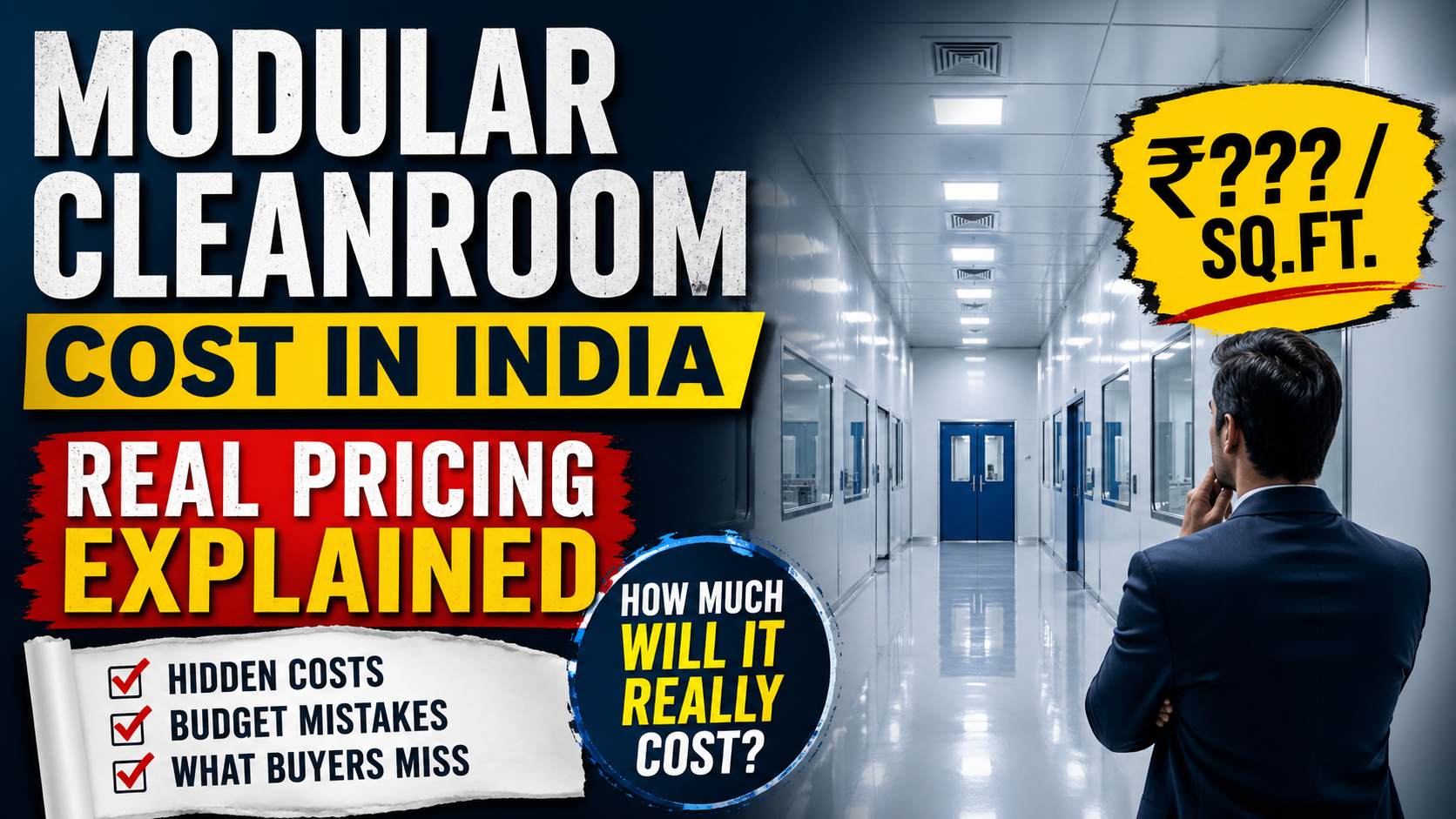
Modular cleanroom pricing in India typically refers to the total project investment required to build a controlled environment using prefabricated wall systems, ceilings, HVAC integration, doors, clean utilities, and validation-ready infrastructure. The final cost depends on classification level, regulatory requirement, MEP complexity, cleanroom application, and how early technical decisions are made.
If someone gives you a flat cleanroom cost without asking what you manufacture, what classification you need, what utilities exist, and whether validation is required, that number is probably meaningless.
Why Cleanroom Budgets in India Often Go Wrong
Most buyers begin by asking:
“What is your cleanroom per square foot rate?”
That question sounds logical.
In reality, it creates poor budgeting.
A pharmaceutical cleanroom facility and an electronics assembly cleanroom may have the same built-up area but completely different infrastructure requirements.
A diagnostic lab may need controlled airflow but not the same particulate control required in aseptic filling.
A hospital modular OT may require laminar airflow, antimicrobial surfaces, airtight doors, and medical gas integration.
Yet many projects are budgeted using generic assumptions.
Common budgeting mistakes include:
- Ignoring HVAC capacity requirements
- Assuming existing HVAC can support cleanroom operations
- Not factoring BMS integration
- Missing validation costs
- Underestimating electrical loads
- Forgetting cleanroom doors and interlocking systems
- Excluding pass boxes and material movement planning
- Not accounting for future regulatory upgrades
This becomes worse in retrofit projects where existing building limitations create major design constraints.
Low ceiling height, structural beam interference, poor duct routes, and electrical load limitations can significantly increase project cost.
What Actually Drives Modular Cleanroom Pricing in India
Cleanroom pricing is influenced by multiple technical variables.
Cleanroom Classification
Higher classification means tighter particulate control.
An ISO Class 8 room is significantly less expensive than an ISO Class 5 sterile manufacturing zone.
Higher classification increases:
- Air changes per hour
- HEPA filtration requirements
- Validation complexity
- Differential pressure controls
- Monitoring systems
ISO reference: International Organization for Standardization
Type of Industry
A food processing cleanroom differs from:
- Pharmaceutical manufacturing
- IVF labs
- Semiconductor facilities
- Hospitals
- Medical device manufacturing
Pharma projects aligned with World Health Organization and Schedule M typically require higher investment due to documentation and validation requirements.
FDA-regulated export facilities often spend even more because documentation expectations are stricter.
U.S. Food and Drug Administration
Wall and Ceiling Material
This changes both initial cost and lifecycle cost.
Common options include:
PUF panels are widely used due to affordability and faster installation.
Rockwool panels are preferred when fire resistance becomes important.
GI powder-coated systems are common in healthcare environments.
HPL and stainless steel finishes are used in higher hygiene applications.
Cheap panels may reduce upfront cost but often create long-term maintenance issues through dents, corrosion, and joint failures.
For facilities needing specialized enclosure systems, many projects integrate solutions from cleanroom infrastructure providers.
HVAC Design Complexity
This is where most budgets escalate.
HVAC often contributes 35% to 50% of total cleanroom project cost.
It includes:
- AHUs
- HEPA filtration
- Ducting
- Chillers
- VRF systems (in selective projects)
- Return air systems
- Pressure balancing
- Temperature control
- Humidity control
Poor HVAC design can fail validation even if interiors look perfect.
This happens frequently in rushed pharma projects.
Doors and Access Control Systems
People underestimate door costs.
That mistake shows up late.
Cleanroom doors may include:
- Airtight doors
- Hermetic sliding doors
- Interlocking doors
- Vision panels
- Emergency access systems
For healthcare and pharma environments, properly engineered cleanroom doors and PUF insulated doors often become critical for maintaining pressure integrity.
In hospitals, operation theatre doors and ICU doors carry very different specifications.
Approximate Modular Cleanroom Project Cost in India
This varies heavily by application.
Basic non-critical cleanrooms may begin around ₹2,500 to ₹4,500 per sq ft.
Mid-level regulated facilities often range between ₹4,500 to ₹8,500 per sq ft.
Highly controlled pharma sterile environments can exceed ₹10,000 to ₹18,000+ per sq ft depending on validation and automation requirements.
Hospital modular OT projects can vary widely depending on imaging integration, HVAC redundancy, and infection control requirements.
For complete healthcare environments, some clients prefer turnkey project execution to avoid coordination gaps.
These are broad market realities, not universal pricing formulas.
Retrofit projects often cost more than greenfield facilities.
Hidden Costs Buyers Miss
This is where project overruns happen.
Validation and Documentation
Especially in pharma:
- DQ
- IQ
- OQ
- PQ
- Air balancing reports
- Particle testing
- Recovery testing
These are often excluded in early quotations.
Utility Integration
Compressed air
Medical gases
Process piping
Drainage modifications
Electrical upgrades
UPS systems
These can significantly alter final budgets.
Shutdown Losses During Retrofit Work
Operational factories often underestimate production losses during installation shutdowns.
That indirect cost can exceed construction cost in some cases.
Why Lowest Vendor Quotes Often Become Most Expensive
Low bids often exclude:
- HEPA terminal boxes
- Dynamic pass boxes
- BMS integration
- Testing
- Documentation
- AMC requirements
Some vendors quote only interiors.
Others quote interiors plus HVAC.
Others quote complete turnkey execution.
Clients compare all three as if they are identical.
That creates procurement disasters.
How Buyers Should Budget Correctly
Before asking for quotes, define:
Your cleanroom classification
Regulatory obligations
Product type
Personnel flow
Material flow
Future expansion plans
Validation expectations
Utility availability
Production volume goals
Without these answers, quotations remain inaccurate.
For hospitals planning controlled surgical infrastructure, early planning for modular operation theatres reduces expensive redesigns later.
For pharma, dedicated planning for compliant environments is essential in facilities serving pharmaceutical production.
Common Execution Mistakes That Increase Cost
Late HVAC redesign
Civil readiness delays
Improper slab leveling
Wrong door dimensions
Utility clashes above false ceilings
Poor drainage planning
Improper pressure zoning
Delayed client approvals
These issues regularly delay handovers by weeks.
Sometimes months.
Should You Choose Modular Over Conventional Construction?
In most controlled environments, yes.
Modular systems offer:
Faster installation
Cleaner execution
Better finish consistency
Easier future expansion
Lower contamination risk during installation
Simpler maintenance access
Conventional masonry still makes sense in limited low-control environments.
But for regulated facilities, modular usually wins.
Future Pricing Trends in India
Cleanroom projects are becoming more expensive due to:
Rising steel prices
Imported component dependency
Higher validation expectations
Energy efficiency upgrades
Automation integration
Schedule M revisions in India may further push compliance-driven investments upward.
Ministry of Health and Family Welfare
Facilities built cheaply today may require expensive upgrades tomorrow.
That is becoming a serious issue in smaller pharma plants.
What Smart Buyers Do Differently
They stop asking:
“What is your lowest price?”
They start asking:
“What will this facility cost to operate, maintain, validate, and scale?”
That single mindset shift prevents major capital mistakes.
The right cleanroom is not the cheapest one.
It is the one that clears audits, runs efficiently, and avoids repeated modifications.
That is what experienced project teams optimize for.
FAQs
What is the average modular cleanroom cost in India?
Most projects range from ₹2,500 to ₹18,000+ per sq ft depending on application, classification, and compliance requirements.
Why is HVAC so expensive in cleanrooms?
Because airflow control, filtration, temperature stability, and pressure balancing are critical to contamination control.
Are retrofit cleanrooms more expensive?
Usually yes. Existing structural and utility limitations often increase engineering complexity.
How long does modular cleanroom installation take?
Smaller projects may finish in 6 to 10 weeks. Large regulated facilities may take several months depending on validation scope.
Is validation included in cleanroom pricing?
Not always. Many vendors exclude validation from base pricing, so always clarify this early.
Final Thought
A cleanroom project should be priced like an operational asset, not an interior contract.
The walls are visible.
The expensive mistakes usually sit above the ceiling, behind duct lines, inside validation reports, and in assumptions nobody questioned early enough.
That is where experienced execution teams create real savings.
For integrated planning, execution support, or controlled environment infrastructure guidance, buyers often review specialized providers through their services division or connect directly via their contact page.